Search “SMS autoresponder” and you will land on marketing software. Broadcast campaigns, subscriber lists, drip sequences, keyword triggers, click tracking. For a marketing team that is exactly right. For a one-van plumber, a two-person HVAC crew, or a solo electrician, most of it is machinery you will pay for and never use.
The confusion is real: “autoresponder” describes three genuinely different tools that solve three different problems. Buying the wrong one is why so many small service businesses pay a monthly fee and still lose the lead.
This guide separates the three types, helps you pick the one your business actually needs, and walks through setup — including the version that runs on the Android phone already in your truck.
Quick answer
A small service business almost always needs a reply-to-call autoresponder — an automatic text sent when you miss a phone call — rather than a marketing broadcast platform. It should send from your existing number, ask one triage question, and let the customer reply into a conversation you will actually see. Broadcast marketing tools are for businesses with a list to nurture, which is a different job.
First: what an SMS autoresponder actually is
Strip away the vendor language and an autoresponder is a rule plus a message:
- Something happens — a message arrives, a keyword is texted, or a call goes unanswered.
- A rule matches that event.
- A prewritten SMS is sent automatically.
Everything else — dashboards, integrations, campaign builders, analytics — sits on top of that loop. When you evaluate a tool, the only question that matters is which event triggers it and who the message goes to.
The three types, and what each is for
| Type | Trigger | Who receives it | Built for |
|---|---|---|---|
| Reply-to-call | An incoming phone call goes unanswered | The person who just called you | Service businesses and solo trades |
| Keyword / auto-reply text | Someone texts a word or number to your line | The person who texted you | High-volume support, bookings, promotions |
| Marketing broadcast | Your schedule or a campaign action | Your subscriber list | Businesses running promotions to many people |
These overlap in vendor marketing, but they are not interchangeable. Buying a broadcast platform to solve a missed-call problem is like buying a delivery truck to answer your front door.
1. Reply-to-call: the missed-call autoresponder
The event: someone dials your business number and you do not pick up.
The message: a short SMS that acknowledges the miss and asks one useful question.
Why it exists: for a service business, an unanswered call is usually not a lost conversation yet — it is an unconverted one. The caller still needs the job done. A text that arrives within seconds keeps you in the running while you are under a sink or on a roof.
What it must do: send from the number the customer dialed, exclude people who should not get a business reply, and be editable in your own words.
Cost model: usually a small monthly subscription, sometimes bundled inside a larger platform.
2. Keyword / auto-reply text responders
The event: a customer sends a specific text to your line — “PRICES”, “HOURS”, “BOOK”, or a number from a sign or van decal.
The message: the information or next step tied to that keyword.
Why it exists: it deflects repetitive questions and turns printed material — yard signs, truck lettering, business cards — into an instant reply channel without a person typing.
Where it fits a service business: this is a genuine convenience, but it is a secondary tool. Most trade businesses do not receive enough inbound keyword texts to justify a platform subscription on their own.
3. Marketing broadcast autoresponders
The event: a schedule you set, or a campaign you launch.
The message: promotional content sent to everyone on your list — seasonal offers, reminders, reactivation sequences.
Why it exists: to drive repeat business and fill slow weeks from an audience that already opted in.
Where it fits: only after you have a list, consent to message it, and something worth saying. For a solo operator, this is usually a later-stage tool, not the first thing to buy.
The vendors who rank for these terms have built excellent broadcast platforms. That is why the search results look the way they do — and why it is so easy to buy the wrong product.
Which one does your business need?
Work down this list and stop at the first “yes”:
- Do you regularly miss calls while working? → You need reply-to-call. This is the highest-value automation for nearly every service business.
- Do you print your number on signs, vans, or cards and get repetitive text questions? → Add keyword replies later, once call handling is solved.
- Do you have an opt-in list of past customers and want repeat work? → Consider broadcast marketing, but only with consent and a real offer.
If you answered yes to the first question, everything below applies to you.
Why the reply-to-call case gets overlooked
Three reasons:
The marketing framing is louder. Search the term and you get campaign software, because marketing platforms invest heavily in ranking for it. Your problem is not marketing — it is coverage when your hands are full.
It is easy to assume voicemail is enough. Voicemail asks the caller to leave a message and wait. Many callers, especially on a phone, will not do either. They dial the next business.
It feels like it needs an office. Answering services and receptionists solve the problem with people, which is expensive and often overkill for one truck with one phone.
An automatic text-back is the smallest tool that closes the gap.
How a reply-to-call autoresponder works, step by step
- A customer calls your business number.
- You do not answer — you are driving, working, or with another customer.
- The system recognizes the unanswered call.
- Your prewritten message is sent to the caller.
- The caller replies with the detail you asked for.
- You follow up when your hands are free.
The automation handles the first touch. You still handle the customer relationship, the quote, and the job.
Setup in six steps
- Pick three messages, not thirty. An urgent version, a standard service version, and a quote-request version cover most of what a small service business receives.
- Write like you talk. “Hi, this is [Business]. Sorry we missed your call — what do you need?” outperforms anything that sounds like a help desk.
- Add exclusions. Family, suppliers, and repeat robocallers should never receive a business reply.
- Decide your hours. Many owners run a different message after hours, or none at all. An automatic “we will reply tomorrow” is better than silence and better than implying round-the-clock service you do not offer.
- Test from a second phone. Confirm the text sends from your number, the reply lands where you will see it, and the wording reads correctly on a small screen.
- Review weekly. Keep the wording that produces useful replies. Rewrite anything customers misread.
Compliance: the short version that keeps you out of trouble
Business texting is regulated, and the rules do not care that you are a one-person operation.
- Responding is not marketing. A reply to a call someone made to you is transactional. Do not enroll that person in promotional messages because they called once.
- Consent is specific. Permission to text back is not permission to market. Get opt-in for promotions separately, in writing.
- Never buy a list. Purchased numbers and auto-texts are how small businesses end up with complaints and carrier problems.
- Honor opt-outs immediately and permanently. When someone says stop, stop — and keep them stopped.
- Identify yourself. Every message should make clear which business is texting.
- Mind your platform permissions. Android call and SMS access are sensitive permissions, and Google Play requires apps to use them for an allowed core function.
Choosing how to run it: platform, forwarding, or on-device
This is where products genuinely differ, and the choice affects your phone number, your bill, and your resilience.
Marketing/CRM platforms usually route through a VoIP number or require porting your existing line. They are the right answer if you also want a CRM, team inboxes, and campaign tools — and the wrong answer if you only want missed-call coverage.
Call forwarding setups keep your number with your carrier but route unanswered calls to a third party. They work, but the configuration can break silently after a carrier change, phone reset, or OS update, and the reply may come from a different number than the one the customer dialed.
On-device apps run on the phone you already carry, detect the missed call locally, and send from your own SIM. No porting, no forwarding rule to maintain, and the customer sees the number they called. The trade-off is that the automation depends on that phone being on and connected — the same limitation as any phone-based tool.
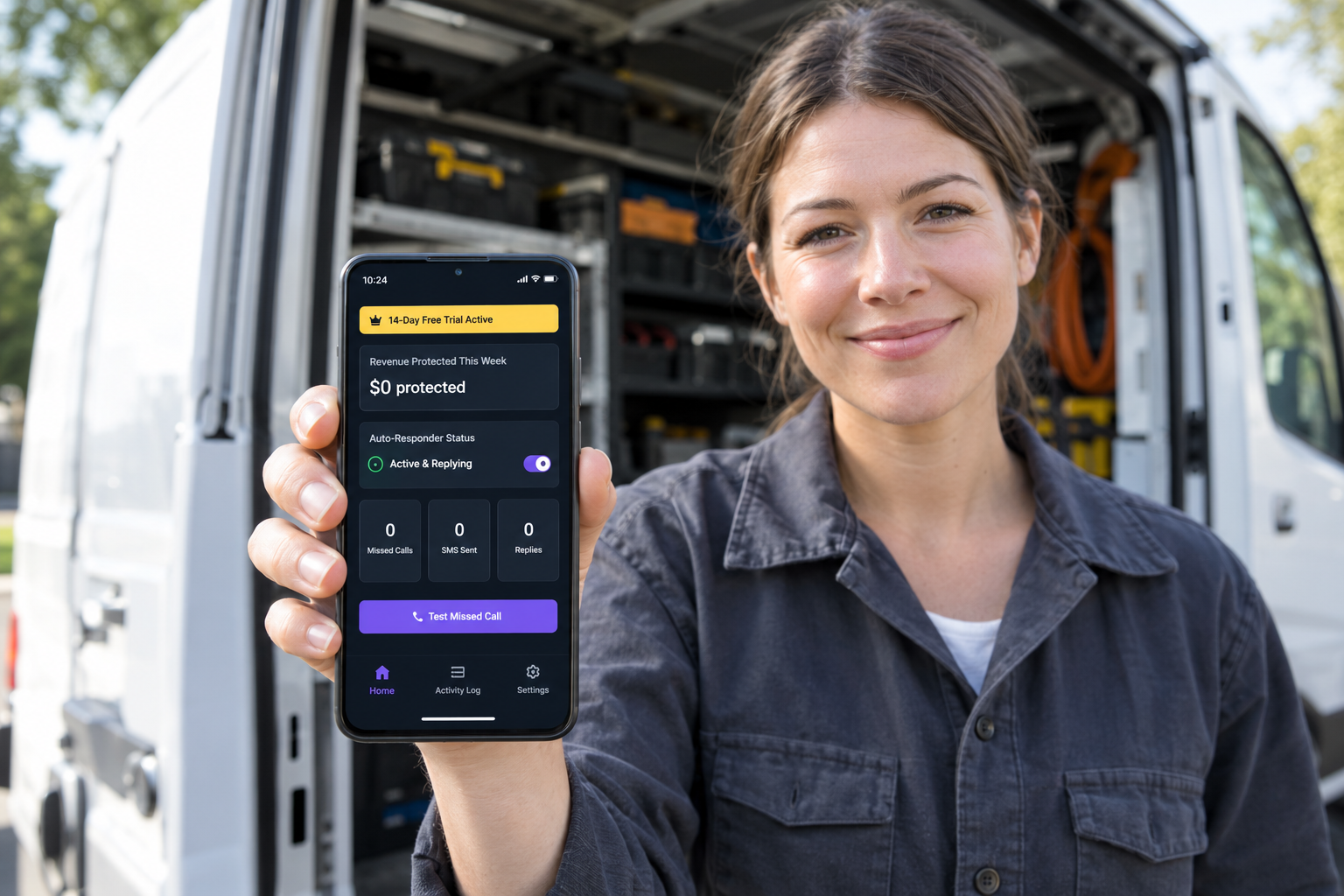
For solo operators and small crews, the on-device path is usually the one with the fewest moving parts. SnapBack Pro is an Android app built around it: your phone, your SIM, editable message wording, and exclusions so a family member or a robocall never gets a business reply.
That said, the tool is not the point. Any of the three routes can send the message in this guide.
Common mistakes small businesses make
- Buying a campaign platform for a call-coverage problem. Expensive and unused.
- Writing a message that promises what you cannot deliver. “We will call you back within the hour” is a commitment, not a courtesy.
- Asking five questions. The customer is standing in a flooded basement, not filling out an intake form.
- Never excluding anyone. Your spouse and the robocallers should not be in your business funnel.
- Setting it up and forgetting it. Messages decay. Re-read yours every month.
- Sending the same text to a warranty caller as to a new lead. Existing customers deserve a different tone.
FAQ
What is the difference between an SMS autoresponder and missed call text back?
An SMS autoresponder is the general category: a rule that sends an automatic text. Missed call text back is one specific type — a reply triggered by an unanswered phone call, sent to the person who called. For most service businesses, that is the type that matters.
Do I need a marketing platform for missed call text back?
No. A marketing platform is built for sending campaigns to a list. If your goal is responding to calls you could not answer, you need reply-to-call automation, which is available in simpler tools — including on-device apps that use your existing phone and number.
Is an autoresponder the same as an answering service?
No. An answering service uses people to answer or return calls. An autoresponder sends a text automatically. An answering service costs far more but can qualify and book work live; an autoresponder is cheaper, instant, and limited to starting the conversation.
Do automatic business texts need customer consent?
A response to a call the customer made to you is transactional, not marketing. Promotional messages to a list require separate opt-in. Never buy a list, and honor stop requests immediately.
Conclusion
“SMS autoresponder” is one phrase covering three different tools, and the search results overwhelmingly point small businesses toward the marketing one. Most service businesses do not need campaign software — they need a reply when they cannot pick up the phone.
Decide which type you need, write three honest messages, exclude the people who should not get a business reply, and test it from a second phone. Then choose the delivery route that fits how you already work.
If you want the on-device route, SnapBack Pro is an Android app that sends missed-call text-backs from the phone and SIM you already use. For the surrounding detail, see how to automatically text back missed callers on Android, missed call text back without porting your number, and the trade playbooks for plumbers, roofers, and HVAC.
Stop losing jobs to missed calls
SnapBack texts every missed caller back in seconds from your real number and SIM — no porting, no VoIP, no answering service. Free 2-week trial, Android.

4 responses to “SMS Autoresponder for Small Business: Which Type You Actually Need”
[…] solve a single problem. Our comparison of the three routes covers that decision in detail, and the SMS autoresponder pillar explains which type of responder fits which […]
[…] call text back without porting your business number explains how the on-device route works, and the SMS autoresponder pillar covers which type of responder fits which […]
[…] Write one version using the formula, test it on your own phone, and watch reply rates. If you want ready-made wording by trade, the templates article has fifteen; if you are still deciding how to automate the send at all, start with which type of SMS autoresponder you actually need. […]
[…] For more detail, see the guide to missed call auto text apps for Android. If you are still working out which type of responder your business actually needs, start with the SMS autoresponder guide for small businesses. […]