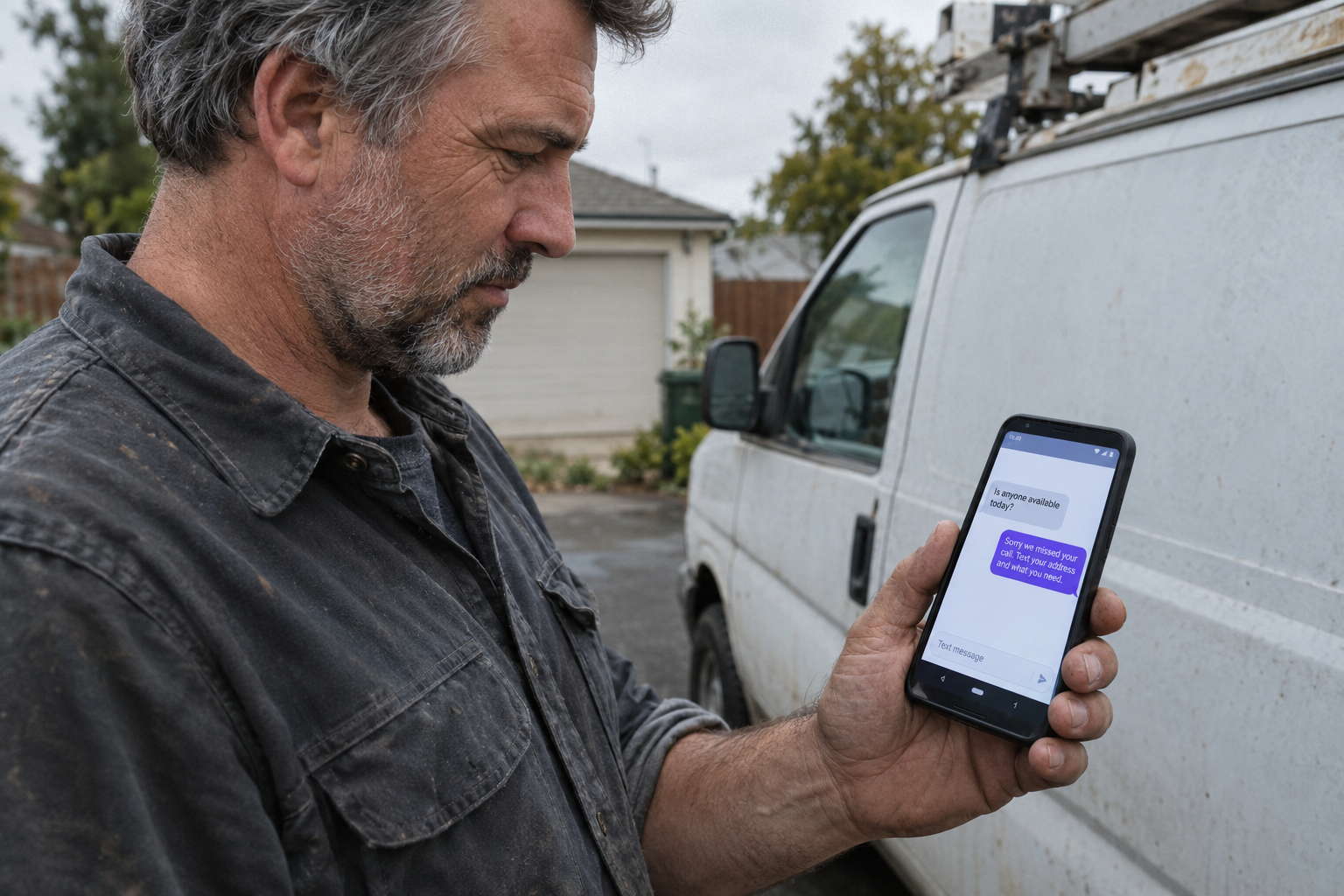
Search “best auto reply message for business” and you get four hundred example messages. What none of them tell you is the thing that decides whether your auto-reply earns a reply of its own: an auto-reply is read in about two seconds by someone who is mildly annoyed. They called, you did not pick up, and now a text has arrived. That is the entire context.
So the best message is not a clever phrase. It is a structure — four parts, in order, under a length limit most people never think about.
Quick answer
The best missed-call auto-reply does four jobs in one message: says who you are, acknowledges the missed call, asks for what you need to act, and sets an expectation for the reply. Keep it under 160 characters, skip links and emoji, and make the ask something the customer can answer in one line. Anything that does not do those four things is decoration.
Why most auto-replies fail
Look at the standard examples and the failure modes repeat.
1. The dead-end thank you. “Thank you for contacting us. We will get back to you shortly.” This is polite and asks for nothing. The customer’s turn is over, and your turn requires you to call back blind — no address, no job detail, no idea whether it is an emergency or a tire-kicker. You have spent a text to learn nothing.
2. No name attached. “Sorry we missed you!” reads like a machine, because it is one. A named human changes the temperature of the exchange, and it costs one word.
3. The essay. Long auto-replies get skimmed and can split into multiple SMS segments, which arrive as two messages, can land out of order, and cost more.
4. The vague ask. “Let us know how we can help” requires the customer to compose a paragraph. People do not. “Text your address and what needs fixing” requires one line, and busy people send one line.
The four-part formula
Identity + Acknowledgment + Direction + Expectation.
| Part | Job it does | Example fragment |
|---|---|---|
| Identity | Proves a real business, not a bot | “This is Dave at Riverside Plumbing.” |
| Acknowledgment | Names the missed call so it does not feel ignored | “Sorry we missed your call.” |
| Direction | Gives one easy, specific action | “Text your address and what you need.” |
| Expectation | Says when they will hear back | “We’ll reply within the hour.” |
Assembled, that is one message: “This is Dave at Riverside Plumbing — sorry we missed your call. Text your address and what you need and we’ll reply within the hour.”
That is 133 characters. It fits in a single SMS segment, it is answerable in one line, and it tells the customer exactly what happens next.
The 160-character limit most people never plan for
This is the part the listicles skip, and it changes how you write.
A standard SMS segment carries 160 characters using the GSM-7 character set. But if your message contains any character outside that set — including any emoji — the whole message switches to UCS-2 encoding, and the single-segment limit drops to 70 characters. Messages longer than the limit are split and concatenated: roughly 153 characters per segment in GSM-7, or 67 in UCS-2.
What that means in practice:
- An emoji can triple your message count. A 140-character message with one emoji becomes three segments instead of one. On a per-message plan you pay three times, and the customer sees it arrive in pieces.
- Splitting can reorder. Concatenated segments usually reassemble correctly, but they are not guaranteed to arrive in order.
- The practical target is 160 characters or fewer, no emoji. Your message is a service message, not a marketing flourish. Save the emoji for the conversation after the customer replies.
If you want to check a draft, any SMS segment calculator will show you the count and where the encoding flips.
Choose the message by why they called
The same four-part formula produces different messages depending on what the caller needs. Matching the message to the call reason is what separates a real operation from a generic one.
The emergency caller. Shortest possible message, fastest possible expectation-setting. If someone is describing active water damage, your text needs to promise a human, not a process. “Dave at Riverside Plumbing — sorry we missed you. If this is urgent, text the address now and we’ll call you straight back.” Note that this asks for the address, not a description.
The price shopper. They called for a number. The auto-reply should not quote a price — it should start the qualification that turns into one. Ask for the job and the location, because those are the two variables that determine the number.
The existing customer with a warranty question. These calls are the ones most likely to be answered by a text rather than a phone call, because the customer wants a record. Ask them to text the detail rather than promising a callback.
The after-hours caller. Different problem: your reply is competing with a night they are already having. Set the expectation explicitly — “we’re closed now, first thing tomorrow” — and if you offer emergency service, say so in the same message. Do not make someone guess whether they should call someone else.
The caller who dialed the wrong number. A specific ask (“text your address”) filters these out on its own, because they will not send one.
The repeat caller. Someone ringing twice in ten minutes is not twice as interested — their first call did not go through, or they lost their nerve. This is where per-missed-call automation goes wrong: if your setup fires a fresh text on every missed call, this person gets two identical messages, which reads as broken. Either delay the second send by roughly twenty minutes or suppress it. Our walkthrough of the GoHighLevel setup covers that fix on that platform specifically.
For a full copy-paste library organised by trade — plumbing, roofing, HVAC, electrical and general contracting — see our 15 missed-call text-back templates. This article is the decision logic; that one is the word bank.
Keep service replies separate from marketing
A reply to a call and a promotional campaign are different use cases, but automated business texts can still raise consent, opt-out and carrier-policy questions. Identify your business, respond only to the call the customer made, honor opt-outs, avoid promotional links and follow-ups unless you have an appropriate basis, and check the applicable rules for your jurisdiction and carrier. Do not assume sending from a personal SIM exempts you from those rules.
Set quiet hours to match what your business can actually handle. If an urgent caller cannot wait for your next opening, your message should not imply that someone is monitoring replies. Get qualified advice on your specific texting workflow before scaling it.
The mistake that undoes all of it
An auto-reply is the first half of a conversation, and the second half is a human.
The fastest way to make an automated message worse than silence is to send it and then not follow up. A customer who receives “we’ll reply within the hour” and hears nothing for a day has been given a written promise and then ignored — which is more annoying than a call that simply went unanswered. If you set an expectation in the text, someone has to own meeting it. If nobody can, promise less: “we’ll get back to you today” only if that is true.
Test the message as a missed caller would
From a second phone, call your business number and let it ring unanswered. Read the text that arrives: does it identify the business, acknowledge the call and ask one question you can answer easily? Reply with a sample service request and confirm it reaches the inbox the owner actually checks. Try a repeat call and a number you intend to exclude; confirm the rules behave as configured on your device.
Then make the real follow-up: an automatic acknowledgment does not book a job. Compare the wording against the copy-ready contractor templates, and use the Android setup and troubleshooting guide for the phone-side test. Track whether eligible callers reply and whether you follow up, not just how many texts were sent.
FAQ
What is the best auto reply message for a missed call?
One that identifies your business, acknowledges the missed call, asks for one thing you need to act (usually the address and the job), and states when the customer will hear back — kept under 160 characters with no emoji and no link. For example: “This is Dave at Riverside Plumbing — sorry we missed your call. Text your address and what you need and we’ll reply within the hour.”
How long should an auto reply text be?
Aim for 160 characters or fewer, which is one standard SMS segment in GSM-7 encoding. If you include an emoji, the message switches to UCS-2 encoding and the single-segment limit drops to 70 characters, so a message that fits comfortably today can split into three segments tomorrow.
Should an auto reply text include a link?
Not in the first message. A link in an unsolicited business text is one of the strongest spam signals, and it also inflates the message length. Start the conversation with a question instead, and share links once the customer has engaged.
Should you send auto replies at night?
Set a schedule that matches your real availability and applicable rules. Do not send a promotional sequence as a missed-call service reply, and do not promise immediate follow-up if nobody monitors messages overnight.
Conclusion
The best auto-reply message is not the cleverest sentence in a list of four hundred. It is a short one that does four jobs in order, fits in a single SMS segment, and asks for something the customer can type in one line. Then it is a promise that someone actually keeps.
Write one version using the formula, test it on your own phone, and watch reply rates. If you want ready-made wording by trade, the templates article has fifteen; if you are still deciding how to automate the send at all, start with which type of SMS autoresponder you actually need.
Reply to missed callers from your Android phone
SnapBack is designed to text eligible missed callers from your Android phone and SIM, without number porting. See the current offer and permissions on Google Play.

2 responses to “Best Auto Reply Message for Business: What Actually Gets a Reply”
[…] habit, which is not technical: if your auto-reply promises a call back, someone has to make it. The message itself matters more than the tool — an auto-reply that asks for nothing wastes the moment it was sent to […]
[…] you need the rule behind the wording, see how to structure the first reply. If you want the automation, see the Android setup and test guide. A template starts a […]