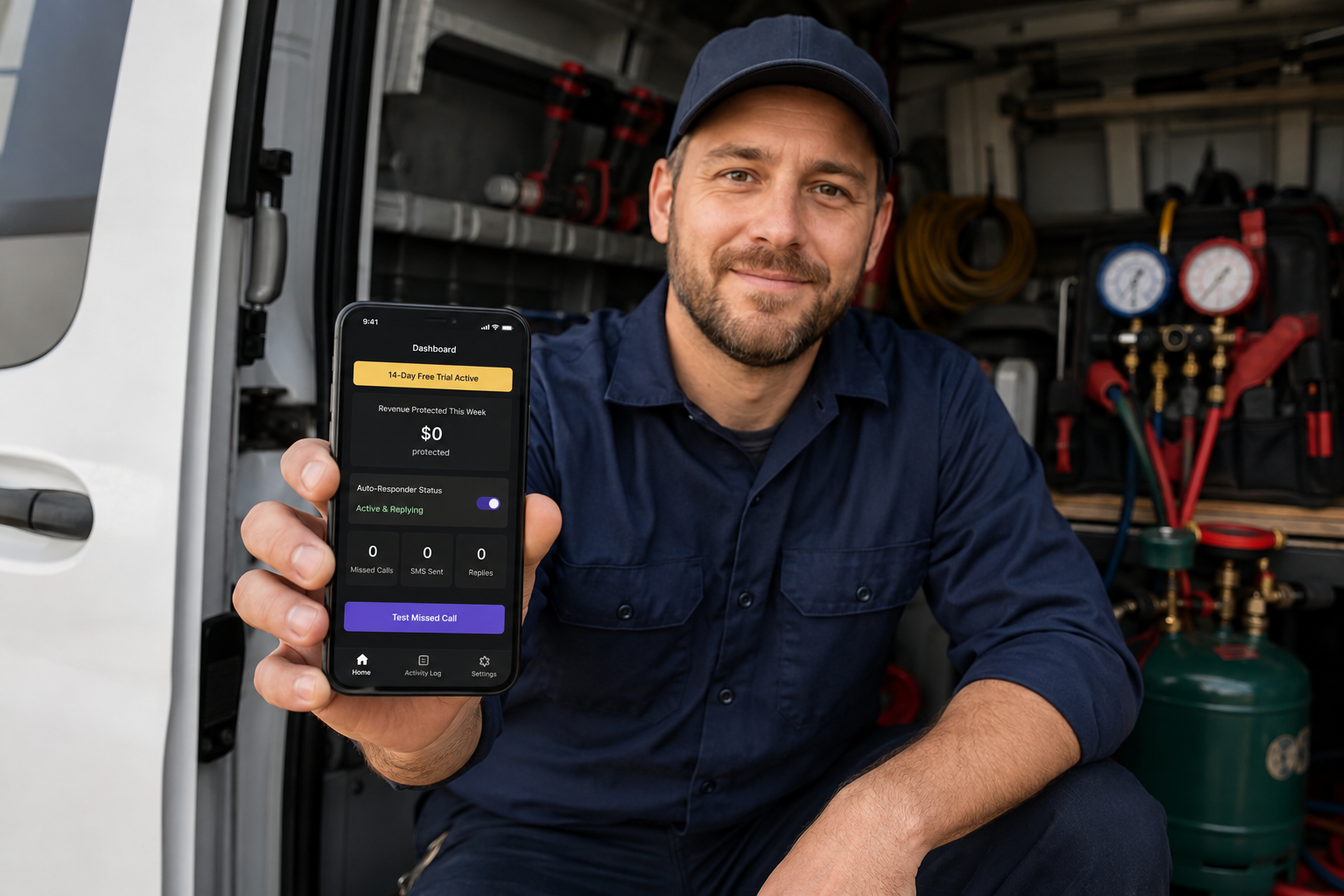
HVAC calls change with the weather. On the first hot day of summer, a homeowner with no air conditioning is not calling for a general callback. In January, a family with no heat has a different level of urgency. A thermostat question, a maintenance request, and a commercial service call should not receive the same automatic reply.
This guide is the HVAC version of missed call text back: what to send in each situation, what never belongs in the first SMS, and how to run it from the Android phone already in your service vehicle.
Quick answer
An HVAC missed-call text back is a short SMS sent automatically after an unanswered call. It should identify the company, acknowledge the missed call, and ask one question that helps triage the request — usually whether the customer has no heating, no cooling, or is calling about maintenance. It should not diagnose equipment, promise an arrival time, or give a repair price by text.
Why HVAC businesses lose jobs when they miss calls
Demand arrives in waves. When temperatures move sharply, every HVAC company receives more calls at once. The customer who cannot reach you may immediately try the next company.
The caller often has an urgent comfort problem. No heat, no cooling, a strange smell, or a system that is making unusual noise all create anxiety. Silence feels like a company that cannot help.
Technicians cannot safely answer on every job. You may be on a roof, handling refrigerant equipment, driving, inside a mechanical room, or speaking with another homeowner. Automatic text-back keeps the first contact moving without asking you to use a phone while working.
HVAC missed-call messages by call type
1. No air conditioning
Hi, this is [Business]. Sorry we missed your call. Is your AC completely off, blowing warm air, or turning on and off? Reply with your address and we will follow up as soon as we can.
That question gives you more useful information than “What is wrong?” without pretending to diagnose the system remotely.
2. No heat
Hi, this is [Business]. Sorry we missed you. Is your heating system completely off, blowing cold air, or showing an error code? Reply with your address and whether anyone in the home is especially vulnerable to the cold, and we will follow up.
The vulnerability question helps you prioritize without promising emergency availability you may not have.
3. Strange smell or possible safety concern
Hi, this is [Business]. Sorry we missed your call. If you smell gas, leave the building and contact your gas utility or emergency services from a safe location. If it is a different smell, reply with your address and what you notice, and we will follow up.
Do not turn a text-back into a remote safety diagnosis. Escalate immediate hazards to the appropriate emergency resource.
4. Thermostat problem
Hi, this is [Business]. Sorry we missed you. Is the thermostat blank, showing an error, or calling for heating or cooling without the system starting? Reply with a photo if useful, plus your address, and we will get back to you.
Thermostat calls are often easy to classify before a callback. Asking for a photo can save a round of questions if the customer is comfortable sending one.
5. Maintenance or tune-up request
Hi, this is [Business]. Sorry we missed your call. Are you looking for heating maintenance, AC maintenance, or a seasonal tune-up? Reply with your address and preferred days, and we will send availability.
Maintenance callers are different from breakdown callers. The message can move directly toward scheduling instead of emergency triage.
6. New installation or replacement estimate
Hi, this is [Business]. Sorry we missed you. Are you replacing a failed system, planning ahead, or comparing options? Reply with your address, system type if you know it, and whether the project is urgent, and we will set up a time.
Do not quote a replacement price before seeing the property, load requirements, existing ductwork, electrical service, and installation conditions.
7. Indoor air quality or ductwork
Hi, this is [Business]. Sorry we missed your call. Are you calling about airflow, dust, humidity, ductwork, or an air-cleaning system? Reply with your address and the main symptom, and we will follow up.
This keeps a broad request from becoming an unqualified sales conversation.
8. Commercial HVAC service
Hi, this is [Business]. Sorry we missed your call. Reply with the property address, equipment type if known, and whether the issue is affecting one zone or the whole building. We will follow up.
Commercial callers often have the detail a residential customer does not. Ask for it early, but keep the first message easy to answer.
9. Warranty or recent installation callback
Hi, this is [Business]. Sorry we missed you. Reply with the property address, installation date if you know it, and what the system is doing, and we will take care of the next step.
A warranty customer should not receive a lead-nurture message. This is a service-recovery moment.
10. Suspected spam or robocall
No message. HVAC companies receive marketing calls, lead sellers, and short-duration robocalls. Exclude personal contacts, known vendors, blocked numbers, and calls that disconnect immediately.
The five rules behind a good HVAC text-back
- Name the company. The caller needs to recognize the sender.
- Acknowledge the miss. Plain language sounds more human than a call-center script.
- Ask one useful question. No customer wants to fill out an intake form by SMS before they know whether you can help.
- Separate safety from service. Gas smells, smoke, sparks, and immediate danger need emergency instructions, not a normal sales follow-up.
- Set an honest expectation. Say you will follow up as soon as you can. Do not promise a dispatch window your schedule cannot support.
What never belongs in an HVAC auto-reply
- A repair diagnosis. A text description is not a measurement, inspection, or safety check.
- A fixed repair price. Parts, access, equipment, and labor can change the actual job.
- A guaranteed arrival time. Weather and active breakdowns affect every route.
- A promise of 24/7 emergency service. Only use it if someone is truly available to respond.
- Detailed safety instructions beyond your competence. For gas, smoke, fire, or carbon-monoxide concerns, direct people to leave the area and contact the appropriate emergency resource.
- A marketing sequence after a breakdown call. Someone with no heat needs a human response, not a newsletter.
Consent and responsible business texting
A reply to a call is not the same as permission to add someone to a marketing campaign. Keep the first message transactional and connected to the call they made.
- Do not purchase a list and send missed-call-style messages to people who did not call you.
- Do not automatically enroll callers in promotional campaigns.
- Honor stop requests.
- Keep your business identity clear.
- Review the Android permissions your app requests. Call and SMS access are sensitive permissions, and Google Play requires apps to use them for an allowed core function.
Running it from the Android phone in your service vehicle
Cloud platforms often use a VoIP number, conditional call forwarding, or number porting. Those approaches can be useful for teams, but they introduce another number, another configuration, or another platform between the HVAC company and the caller.
SnapBack Pro is built for the solo technician or small crew that already runs the business from an Android phone. It uses that phone and SIM, lets you edit trade-specific templates, and supports exclusions so a personal contact or obvious robocall does not receive a business message.
The app is one implementation of the workflow. The durable part is the message: one clear question, no invented promise, and a path for the customer to reply.
Set up the workflow in six steps
- Start with three messages: no cooling, no heat, and maintenance.
- Add an emergency message only after deciding who handles urgent calls.
- Exclude family, suppliers, repeat spam, and blocked numbers.
- Test from a second phone while the Android device is locked and on mobile data.
- Confirm replies arrive where you will actually see them.
- Review the messages weekly. Keep the wording that produces useful replies and remove anything customers misunderstand.
FAQ
What should an HVAC company text after a missed call?
Identify the business, apologize for missing the call, and ask whether the customer needs heating repair, cooling repair, maintenance, or an estimate. For a breakdown, ask one symptom rather than attempting a diagnosis.
Is missed call text back the same as an answering service?
No. Text-back sends an initial SMS after an unanswered call. An answering service may speak to the caller, qualify the job, schedule appointments, and route calls. Choose based on whether you need an automated first touch or live coverage.
Do I need to port my HVAC business number?
Not necessarily. Some platforms use porting or call forwarding. An on-device Android app such as SnapBack Pro runs on the phone and SIM you already use, so the existing number stays with your carrier.
Can I use these HVAC templates in another app?
Yes. The wording works with a CRM, answering service, VoIP platform, or on-device app. Adapt the safety language and availability promises to what your business can actually provide.
Conclusion
For an HVAC company, a missed call often arrives at the exact moment a technician cannot safely answer. A relevant text-back keeps the conversation alive without pretending that an SMS can replace a technician’s judgment.
Separate no-heat, no-cooling, maintenance, installation, warranty, and safety calls. Ask one useful question. Keep prices and diagnoses out of the first message. Then use the phone system that fits your operation.
SnapBack Pro is an Android app for contractors who want missed-call text-back from the phone and SIM they already use, without porting their business number. For the broader workflow, read the contractor text-back templates, Android setup guide, plumbing playbook, and roofing playbook.
Stop losing jobs to missed calls
SnapBack texts every missed caller back in seconds from your real number and SIM — no porting, no VoIP, no answering service. Free 2-week trial, Android.