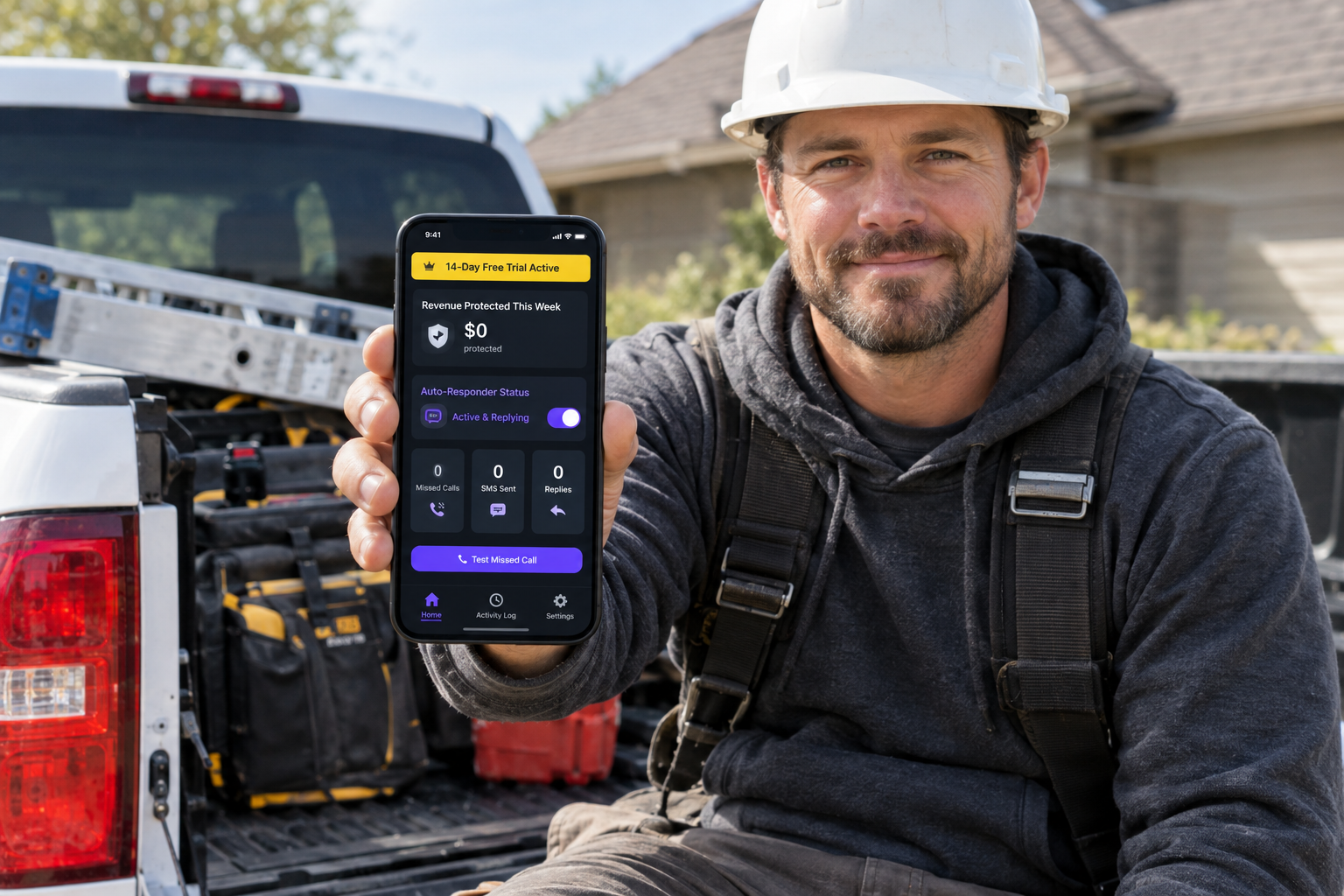
Roofing calls have a seasonal heartbeat. A calm Tuesday in March is nothing like the Monday after a hailstorm. A homeowner calling about a small leak and a property manager calling about a full replacement are different customers with different urgency, and a single generic “Sorry we missed you” text does not serve either of them well.
This guide is the roofing version of missed call text back: what to send, in which situation, what never to put in the message, and how to run it from the Android phone already on your truck dash.
Quick answer
A roofer’s missed call text back is a short SMS sent automatically when an incoming call goes unanswered. It should name your business, admit the miss, and ask exactly one question that lets you triage the job — usually whether there is active water coming in and what type of roof it is. It should never quote a price sight unseen, promise a same-day inspection, or diagnose damage over text.
Why roofing is a bad trade to miss calls in
Three things make roofing calls especially costly to miss:
Weather is the clock. After a storm, homeowners call every roofer in the area at once. The first one to reply with a sane question gets the inspection slot. The ones who send voicemail or silence get skipped.
The job value is high. A missed roofing call is not a $150 service call. It is often a $10,000–$30,000 replacement. The customer knows the stakes and expects responsiveness.
You are literally on a roof. Ladders, steep pitches, heat, and safety harnesses mean you cannot pick up every ring. The automation is not a convenience — it is a safety necessity.
The exact messages, by roofing call type
1. Active leak or emergency water intrusion
Hi, this is [Business]. Sorry we missed your call. If water is actively coming in, place a bucket under the drip and move anything that can be damaged. Reply with your address, roof type (shingle, metal, flat), and how long it has been leaking. We will get back to you as soon as we can.
The bucket instruction is doing real work while you are still tied up. It also signals that you have handled this before.
2. Storm or hail damage (recent weather event)
Hi, this is [Business]. Sorry we missed your call. If you are calling about recent storm damage, reply with your address and whether you see missing shingles, dents, or leaks inside. We will schedule an inspection as soon as we can.
This separates storm-chaser urgency from routine maintenance and tells you whether the caller has interior damage or just exterior concern.
3. Estimate or replacement request (non-urgent)
Hi, this is [Business]. Sorry we missed you. Happy to look at this for you — reply with the property address, approximate age of the roof, and whether you own or rent, and we will get you a time for an estimate.
Age and ownership are the two facts that change every estimate conversation.
4. Roof inspection request (insurance, real estate, preventive)
Hi, this is [Business]. Sorry we missed your call. Reply with the property address and what the inspection is for — insurance claim, home sale, or preventive maintenance — and we will set up a time.
Insurance inspections require documentation discipline. Home sale inspections are time-bound. Maintenance inspections are relationship-builders. The reply tells you which playbook to open.
5. Warranty or callback on previous work
Hi, this is [Business]. Sorry we missed you — reply with the address we worked at and what is happening, and we will take care of you.
Warranty messages should not sound like a sales funnel. The customer already paid. This is retention.
6. Commercial or multi-unit property
Hi, this is [Business]. Sorry we missed your call. Reply with the property address, number of units or square footage if you know it, and whether this is an emergency or a scheduled project, and we will follow up.
Commercial callers often have more detail than residential callers. Ask for it early.
7. Gutter, fascia, or soffit work (related but not roof replacement)
Hi, this is [Business]. Sorry we missed your call. Reply with what you need — gutters, fascia, soffit, or the roof itself — and your address, and we will let you know if it is in our scope.
This prevents the “I thought you did gutters” mismatch that wastes everyone’s time.
8. Known customer or referral
Hi [name], it is [Business]. Sorry I missed you — what do you need?
For repeat customers and referrals, warmth beats process. If your app allows contact-specific messages, this is where to use them.
9. Suspected spam or robocall
No message. Roofing businesses get storm-chaser robocalls, warranty scam calls, and lead-aggregator spam. An auto-text to a robocall invites more spam. Use exclusions and a short hang-up threshold.
The five rules behind all of it
- Name the business. The caller needs to know the text is from the roofer they just dialed.
- Admit the miss in plain language. “Sorry we missed your call” beats any corporate phrasing.
- Ask one question, not four. The reply should be possible with one thumb while looking at a ceiling stain.
- Ask about urgency in roofing terms. Water coming in, storm damage, missing shingles — these are the facts that determine your next move.
- Set an honest expectation. “We will get back to you as soon as we can” is enough. Do not promise a same-day inspection if your week is already full.
What never belongs in a roofing text-back
- Prices. A roof price needs eyes on the pitch, the layers, the decking, and the access. Any number you give over text becomes the anchor you cannot move.
- Inspection times. Weather, crew availability, and the job before you all move. Promise a window and you own it.
- Diagnoses. “Sounds like wind damage” over text can be wrong, and it becomes your liability.
- Insurance advice beyond the basics. Telling a homeowner to “call your insurance” is fine. Advising them on coverage, deductibles, or claim strategy is not.
- Marketing drip on an emergency. A homeowner with water coming through the ceiling is not a nurture candidate.
Running it from the phone in your truck
Most missed-call products route your calls through a VoIP number or ask you to port your existing line. For a one-truck roofing business, that means your established number either changes or disappears behind a platform you rent.
SnapBack Pro is built the other way: it runs on the Android phone you already use, sends from that phone and SIM, and includes trade template wording you can edit. It also lets you exclude numbers that should never get a business reply — your family, your suppliers, and the robocall traffic every business number collects.
That said, the app is one implementation. If you prefer a VoIP platform, a CRM, or even a manual rule of “text every missed call back within two minutes,” the copy in this article still applies. The messages matter more than the software.
Setting it up without drama
- Decide the three messages you actually need: emergency (water coming in), storm damage, and estimate request. Skip the long tail at first.
- Write them, then read them out loud. If they sound like a software company, rewrite them.
- Add exclusions: personal contacts, suppliers, repeat robocallers.
- Test from a second phone. Confirm the text sends from your number and that replies land where you will see them.
- Set a rule for your working hours. Many roofers run a different message after hours, or none at all.
- Review once a week. Which replies turned into inspections, and which message wording did the work?
FAQ
What should a roofer text back after a missed call?
Name your business, apologize for missing the call, and ask one triage question relevant to roofing — whether water is actively coming in, or whether the call is about storm damage, an estimate, or a warranty issue. Do not include prices or inspection times.
Is missed call text back the same as a voicemail?
No. Voicemail asks the caller to do work and leaves you to call back. A text-back starts the conversation in writing, in the channel most customers already prefer, and gives you triage information before you pick up the phone.
Do I have to port my number to use it?
Not necessarily. Some platforms require porting or call forwarding. Others, including SnapBack Pro, run on the Android phone and SIM you already have. See our guide to missed call text back without porting for the full comparison.
Can I use these templates if I use a different tool?
Yes. The wording is the durable part. Any app, CRM, or answering service can send it — adapt the roofing specifics to how your business talks to customers.
Conclusion
For a roofing business, missed call text back is not a marketing trick — it is damage control for the sixty seconds after your phone rings and you are on a ladder. Send the right question for the call type, keep prices and inspection times out of the message, and run it on the number you already have.
If you want an Android app that works this way without porting your line, SnapBack Pro is built for that. If you would rather check the general version first, our 15 missed-call text-back templates for contractors covers the same ground across trades, the Android auto-text setup guide walks through the phone settings, and how missed-call auto-text apps work explains what to expect from the category.
Stop losing jobs to missed calls
SnapBack texts every missed caller back in seconds from your real number and SIM — no porting, no VoIP, no answering service. Free 2-week trial, Android.

2 responses to “Roofer Missed Call Text Back: What to Text When You’re on a Roof”
[…] Android, missed call text back without porting your number, and the trade playbooks for plumbers, roofers, and […]
[…] SnapBack Pro is an Android app for contractors who want missed-call text-back from the phone and SIM they already use, without porting their business number. For the broader workflow, read the contractor text-back templates, Android setup guide, plumbing playbook, and roofing playbook. […]